

Table of Contents
Mindfulness practices reduce rumination by pulling your attention out of the mental replay loop and anchoring it firmly in the present moment. If your mind keeps cycling through the same worries, this guide is for you.

Understanding the Rumination Trap
You know the feeling. A stressful conversation from three days ago keeps replaying in your head, word for word. You analyze it, re-argue it, and still feel no resolution.
That is rumination — a cognitive loop of repetitive negative thinking that drains your energy and keeps your nervous system locked in low-grade distress. It is not just annoying; it is genuinely harmful to your health.
Research published in Clinical Psychology Review (NIH/PubMed) links prolonged rumination to higher rates of depression, anxiety disorders, and even cardiovascular problems. The mind-body connection is real, and a spinning mind creates a stressed body.
The good news? Mindfulness practices reduce rumination in measurable, science-confirmed ways — and you can start with just five minutes a day.
Rumination differs from healthy problem-solving. Problem-solving moves forward. Rumination circles back. It asks why did this happen? endlessly rather than what can I do now?
Understanding this distinction is your first step. Once you recognize the loop, you can use mindfulness to step outside it instead of running it for the thousandth time.
It is worth noting early on that mindfulness practices reduce rumination across a wide range of people — from those with clinical anxiety to anyone who simply overthinks daily stressors. The tools work broadly.
The Science Behind Mindfulness Practices Reduce Rumination
The research on mindfulness and repetitive negative thinking is substantial, specific, and encouraging. This is not wellness folklore — it is well-documented neuroscience and clinical psychology.
How Mindfulness Practices Reduce Rumination in the Brain
Rumination is associated with overactivity in the brain’s default mode network (DMN) — the neural system that activates during self-referential thinking and mind-wandering. When you are not focused on a task, the DMN runs the mental chatter.
Mindfulness training strengthens the prefrontal cortex’s ability to regulate DMN activity. A landmark study in NeuroImage (PubMed) found that experienced meditators show significantly reduced DMN activity during rest.
This means their minds do not default to rumination as readily. Mindfulness practices reduce rumination by literally rewiring the brain’s habit of spinning into self-focused negative thought loops.
What MBCT Research Tells Us
Mindfulness-Based Cognitive Therapy (MBCT) is the most rigorously studied program in this field. Researchers at the University of Exeter conducted landmark trials showing MBCT reduces depressive relapse rates by approximately 43% in high-risk patients.
A major part of that benefit comes directly from MBCT’s ability to reduce ruminative thinking patterns. Participants learned to observe thoughts without engaging with them — a skill that is core to all six practices in this guide.
Multiple meta-analyses confirm these findings. A comprehensive review in JAMA Internal Medicine (PubMed) analyzed 47 randomized controlled trials and found mindfulness meditation programs significantly improved anxiety, depression, and stress outcomes.
Debunking the Biggest Myth
Many people believe that thinking harder about a problem will eventually solve it. This feels logical, but for rumination, the opposite is true.
Research consistently shows that trying to suppress or argue with ruminative thoughts actually increases their frequency. This is called the ironic rebound effect — the more you fight a thought, the more it returns.
Mindfulness practices reduce rumination not by suppressing thoughts, but by changing your relationship to them. You observe. You label. You return to the present. That is the mechanism that works.
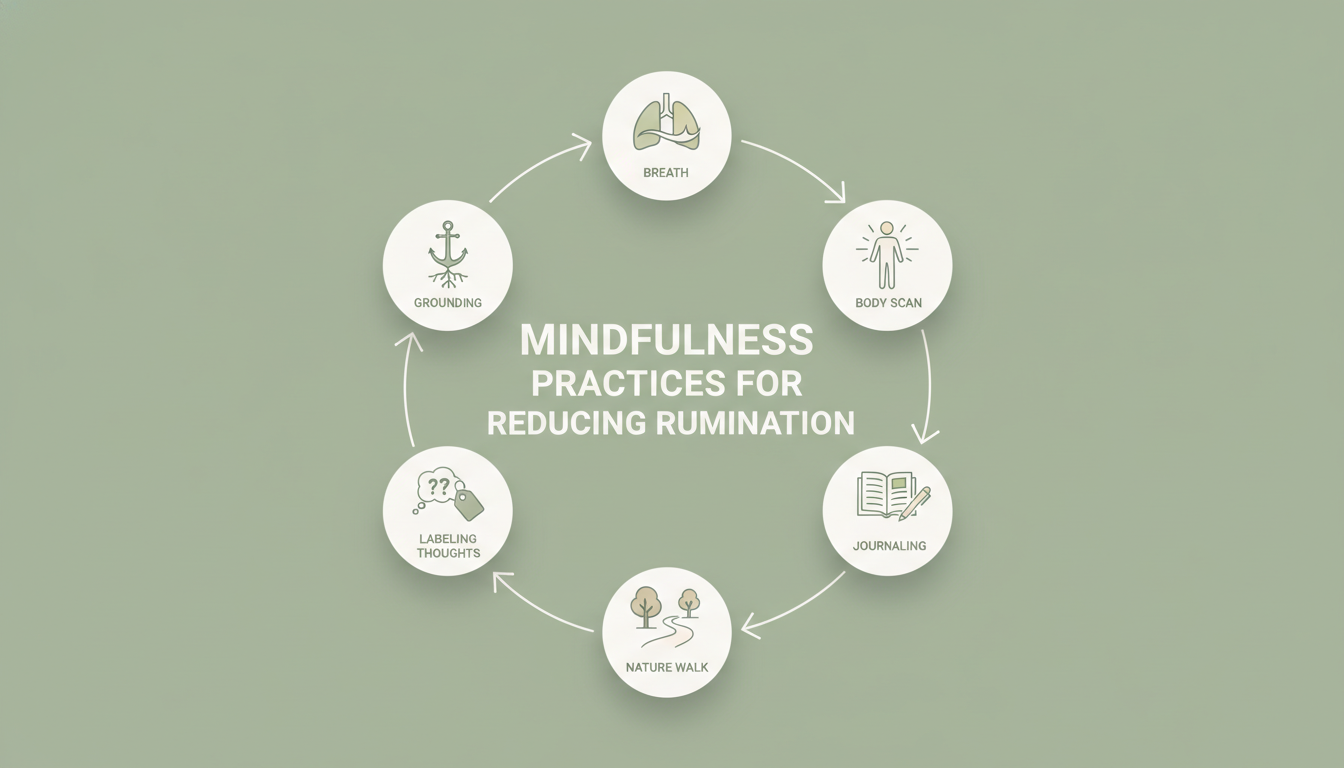
Step-by-Step Mindfulness Practices Reduce Rumination Guide
Here are six evidence-informed practices arranged from simplest to most expansive. Each one is a tested tool for interrupting the rumination cycle. Start with one. Build from there.
Each technique below demonstrates how mindfulness practices reduce rumination through a different entry point — breath, body, cognition, movement, sensation, and writing.
Practice 1: Breath Anchoring (5 Minutes)
This is the foundational mindfulness practices reduce rumination technique. It is the entry point recommended by MBCT programs worldwide, and it requires no equipment, no app, and no prior experience.
How to do it:
- Sit comfortably in a chair with your feet flat on the floor.
- Close your eyes or soften your gaze downward.
- Focus your full attention on the physical sensation of breathing — the rise of your chest, the coolness of air entering your nostrils, the slight pause between inhale and exhale.
- When a ruminative thought appears (and it will), silently label it thinking — without judgment, without engaging with the content.
- Gently return your attention to the breath. Repeat every time a thought pulls you away.
Duration: Start with 5 minutes daily. Progress to 10–15 minutes over two weeks.
What to expect: Your mind will wander constantly at first. That is normal. The act of noticing and returning IS the practice — each return is a mental rep that strengthens your attention muscle.
Practice 2: Body Scan Meditation (10–20 Minutes)
Rumination lives in the head. The body scan deliberately shifts awareness downward, into physical sensation, which is the present moment’s most reliable anchor.
How to do it:
- Lie down or sit comfortably.
- Starting at the top of your head, slowly move your attention through each region of your body — scalp, face, jaw, neck, shoulders, chest, arms, hands, abdomen, hips, legs, feet.
- At each area, simply notice what is there: warmth, tension, tingling, numbness, pressure. Do not try to change anything.
- If a repetitive thought interrupts, acknowledge it, label it thinking, and return to the body region you left.
Duration: 10–20 minutes. Even a 10-minute body scan significantly reduces cortisol levels and interrupts ruminative loops.
Why it works: Physical sensation exists only in the present tense. You cannot feel your left foot in the past or future. This makes the body scan one of the most powerful mindfulness practices reduce rumination tools available.
Practice 3: Thought Labeling
Thought labeling is a cognitive defusion technique drawn from both MBCT and Acceptance and Commitment Therapy (ACT). It creates psychological distance between you and the ruminative story your mind keeps telling.
How to do it:
- When you notice a repetitive thought, pause.
- Instead of engaging with the content, simply name the type of thought: worrying, planning, judging, remembering, catastrophizing.
- You can also use the phrase: I notice I am having the thought that… followed by the thought content.
- Then gently redirect your attention to whatever you were doing — breathing, eating, walking, working.
Why it works: Labeling activates the prefrontal cortex and reduces amygdala reactivity, according to neuroimaging research from UCLA. You go from being inside the thought to observing it from a slight distance.
Thought labeling is especially effective when combined with breath anchoring. Together, these two techniques show how mindfulness practices reduce rumination at both the cognitive and physiological level simultaneously.
Practice 4: Mindful Walking (10–30 Minutes)
For people who find seated meditation difficult, mindful walking is an equally valid and research-supported alternative. Movement can actually accelerate the benefits of mindfulness practices reduce rumination for high-anxiety individuals.
How to do it:
- Walk at a slower-than-normal pace in a quiet space — outdoors is ideal but not required.
- Direct your attention to the physical sensations of walking: the heel striking the ground, the rolling of the foot, the push-off from the toe, the swing of the arms.
- Engage your senses: notice five things you can see, four you can hear, three you can feel on your skin.
- When rumination pulls you into thought narratives, use the same labeling technique — thinking — and return to the physical sensations of movement.
Duration: 10–30 minutes. Even a 10-minute mindful walk has been shown to lower perceived stress.
If you experience afternoon energy dips alongside rumination, see our guide on how to Reduce Afternoon Slump — combining mindful movement with that advice is especially effective.
Practice 5: The 5-4-3-2-1 Grounding Technique (2–5 Minutes)
This is a rapid-deployment tool you can use anywhere, anytime rumination spikes — in a meeting, in bed at night, while driving (eyes open version). It is one of the fastest mindfulness practices reduce rumination techniques in this guide.
- 5 things you can SEE: Deliberately name five objects in your visual field. Be specific — not just “a chair” but “a grey office chair with a small scuff on the armrest.”
- 4 things you can TOUCH: Notice the physical sensations of four surfaces — the texture of your clothing, the temperature of the air, the firmness of the seat beneath you.
- 3 things you can HEAR: Tune in to ambient sounds you were filtering out — distant traffic, the hum of a refrigerator, your own breathing.
- 2 things you can SMELL: Take two slow breaths and identify any scents present, however faint.
- 1 thing you can TASTE: Notice any lingering taste in your mouth, or take a sip of water and focus entirely on its temperature and texture.
This technique works because it forcibly occupies all five sensory channels simultaneously, leaving no cognitive bandwidth for rumination.
It is especially helpful for reducing overstimulation when thoughts feel overwhelming.
Practice 6: Compassionate Journaling (10–15 Minutes)
Not all mindfulness practices reduce rumination through silence. Compassionate journaling is a structured writing practice that externalizes the thought loop, allows you to examine it with self-compassion, and then consciously close it.
How to do it:
- Set a timer for 10–15 minutes.
- Write freely about the ruminative thought or worry — not to analyze it, but to release it onto the page.
- After writing, respond to what you wrote from the perspective of a kind, wise friend. What would that friend say to you? Write that response.
- End each session by writing one sentence beginning with: Right now, in this moment, I can…
This structure is informed by James Pennebaker’s decades of research on expressive writing, which shows that writing about stressful events reduces intrusive thoughts and improves psychological wellbeing.
You can deepen this practice with our guides on Worry Journaling and the complete Stress Journaling Guide.
Mindfulness Practices Reduce Rumination: Mistakes to Avoid
Even well-intentioned practice can backfire if you fall into these common traps. Knowing them in advance saves you weeks of frustration.
Mistake 1: Fighting or Suppressing the Thoughts
The single most common error is trying to push ruminative thoughts out of your mind. As noted earlier, research consistently shows this causes an ironic rebound — the thought returns stronger and more frequently.
Mindfulness practices reduce rumination through observation, not combat. The goal is to notice the thought is present, name it, and redirect — not to silence it by force.
Think of thoughts like clouds passing through sky: you do not need to grab them or push them away. Simply watching them pass is how mindfulness practices reduce rumination most effectively.
Mistake 2: Practicing Only When You Are Already Overwhelmed
Many people only turn to mindfulness when rumination has already reached a peak. At that point, the nervous system is flooded and practice feels impossible, which leads to the conclusion that “mindfulness doesn’t work for me.”
Consistency matters more than crisis intervention. Daily 5-to-10-minute practice during calm moments builds the neural pathways that activate automatically when stress rises.
This is why the science on mindfulness practices reduce rumination emphasizes daily routine over occasional use. Treat it like brushing your teeth — not an emergency measure.
Mistake 3: Judging Yourself for Mind-Wandering
Students of mindfulness often become frustrated when their mind wanders repeatedly during breath anchoring or body scan. They interpret wandering as failure and sometimes quit entirely.
Mind-wandering is not a bug — it is the feature. Each moment you notice your mind has wandered and choose to return is a moment of mindfulness. That noticing-and-returning IS the practice. The more it happens, the more reps you get.
Mistake 4: Treating Mindfulness as a One-Time Fix
Mindfulness is not an intervention you apply once. It is a skill that develops over weeks and months of consistent engagement. Expecting results after one or two sessions sets you up for disappointment.
Research on MBCT uses structured 8-week programs. Even simple daily mindfulness practices produce measurable neurological changes within 8 weeks of consistent use, according to a well-cited study from Harvard Medical School researchers.
Commit to a minimum of 4 weeks before evaluating your results. Within that window, you will have accumulated enough practice for mindfulness practices reduce rumination effects to become noticeable in daily life.
Also consider the broader picture: rumination often worsens alongside poor sleep, overstimulation, and physical stress. Pairing mindfulness with strategies that improve heart rate variability can amplify your results by helping your nervous system reach a calmer baseline more easily.
Start Your Mindfulness Practices Reduce Rumination Journey Today
You do not need a meditation cushion, a retreat booking, or an hour of free time. You need five minutes and a willingness to try something different from the mental wrestling you have been doing.
Here is your starting point — right now, today:
- Set a timer on your phone for 5 minutes.
- Sit in any comfortable position. Close your eyes.
- Place your full attention on the physical sensation of your next breath. Feel the inhale. Feel the exhale.
- When a thought appears — any thought — silently say the word thinking and return to the breath.
- When the timer ends, open your eyes slowly. Notice how you feel compared to five minutes ago.
That is it. That is your first use of mindfulness practices reduce rumination in practice. It is not dramatic. But done daily, it compounds into a fundamentally different relationship with your own mind.
As you build confidence, layer in the other five practices from this guide. Each one targets a different aspect of the rumination cycle, so using several in combination produces stronger results than any single technique alone.
The evidence is clear. Mindfulness practices reduce rumination not by magically emptying the mind, but by training you to observe thoughts without being captured by them.
That skill — observation without engagement — is transformative for anyone struggling with repetitive negative thinking, overthinking, or anxiety-driven mental loops.
You have already taken the first step by reading this far. Your mind is capable of change. The research confirms it, and your next five-minute practice session will begin to prove it to you directly.
Ready to go deeper? Explore our Worry Journaling guide, the full Stress Journaling Guide, and strategies to reduce overstimulation for a complete approach to quieting an overactive mind.