

Table of Contents

Why Chronic Stress Leaves You Stuck
The coherent breathing technique may be the simplest, most evidence-backed reset tool you have never used. If you spend your days feeling wired, tense, and unable to wind down, you are not alone.
Chronic stress quietly dysregulates your autonomic nervous system. Over time, your body defaults to a low-grade fight-or-flight state that it struggles to exit on its own.
Most adults breathe between 12 and 20 times per minute. According to research published in the National Institutes of Health on slow breathing and autonomic function, this faster breathing pattern keeps sympathetic nervous system activation elevated — even when no real threat exists.
The result is a body stuck in alarm mode: elevated cortisol, shallow breathing, poor sleep, and a heart rhythm that never quite settles. Your nervous system needs a deliberate signal to shift gears.
That signal can come from your own breath. Practicing the coherent breathing technique takes just five minutes a day to begin feeling a measurable difference in your nervous system state.
The coherent breathing technique is one of the few self-regulation tools that works on your very first session. You do not need to master it — you simply need to begin.
The Science Behind the Coherent Breathing Technique
What Heart Rate Variability Has to Do With It
The coherent breathing technique works by slowing your breath to exactly 5 to 6 cycles per minute — roughly 5 seconds in and 5 seconds out. This specific pace is not arbitrary.
At this rate, your breath rhythm synchronizes with your heart’s natural oscillation cycle. Scientists call this phenomenon respiratory sinus arrhythmia, and it is the physiological foundation behind the entire practice.
When synchronization happens, heart rate variability (HRV) reaches its peak. HRV is the variation in time between heartbeats and is one of the most reliable markers of nervous system resilience and cardiovascular health.
You can learn more about why this matters in our guide to Improve Heart Rate Variability.
What the Research Actually Shows
Research from the HeartMath Institute has consistently demonstrated that slow, rhythmic breathing at the resonant frequency of approximately 0.1 Hz — which equals 6 breaths per minute — produces the greatest HRV amplification of any voluntary action.
A landmark study published in the American Heart Association’s journal on heart rate variability and autonomic nervous system assessment confirmed that HRV is a direct window into cardiovascular and autonomic health.
Higher HRV is linked to lower anxiety, better emotional regulation, reduced blood pressure, and stronger immune function. The coherent breathing technique reliably increases HRV within a single five-minute session.
The Vagus Nerve Connection
Slow nasal breathing activates the vagus nerve — the primary highway of your parasympathetic nervous system. Each long exhale sends a calming signal through this nerve, telling your heart, gut, and brain that it is safe to relax.
This is why the coherent breathing technique produces noticeable calm so quickly. It is not a placebo. It is direct, measurable neurobiology at work in real time.
Debunking the Myth That Deep Breaths Mean Big Breaths
Many people assume that deep breathing means taking huge, forceful inhales. This is a common misconception that can actually make anxiety worse by causing mild hyperventilation.
The coherent breathing technique does not require large breath volumes. It requires slow, steady, nasal breathing at a controlled pace. The depth is gentle — not dramatic.
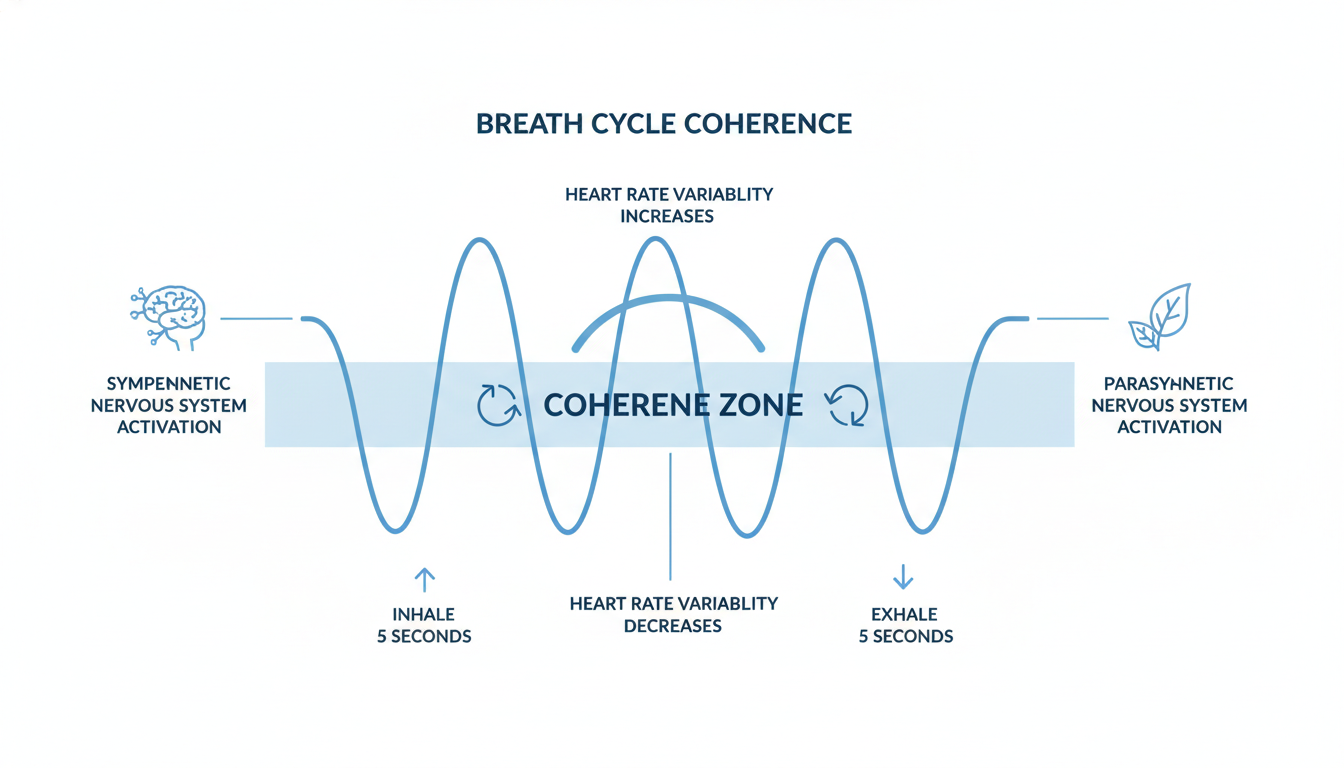
Step-by-Step Coherent Breathing Technique Guide
This is the core of the practice. The coherent breathing technique is remarkably simple, but the details matter. Follow these steps exactly for best results.
Your Complete Coherent Breathing Technique Protocol
Step 1 — Find a comfortable position. Sit upright in a chair with your feet flat on the floor, or lie on your back. Place one hand on your chest and one on your belly. You will use this to check that your belly — not your chest — is doing the work.
Step 2 — Set a timer for 5 minutes. For your first week, five minutes once daily is enough to begin shifting your baseline HRV. Do not skip the timer — it removes the mental effort of tracking time so you can fully relax into the breath.
Step 3 — Inhale slowly through your nose for 5 counts. Count silently: one, two, three, four, five. Feel your belly gently expand outward. Keep your shoulders still and your jaw soft. The breath should feel effortless, not forced.
Step 4 — Exhale slowly through your nose for 5 counts. Count again: one, two, three, four, five. Let your belly fall naturally. Do not push the air out. The exhale should be as passive and relaxed as possible.
Step 5 — Repeat without pausing. Move directly from the exhale back into the inhale. There is no breath hold in the standard coherent breathing technique. The rhythm is continuous and smooth — like a slow, gentle wave.
Step 6 — Complete 5 full minutes, then sit quietly for 60 seconds. After your timer ends, stay still for one more minute. Notice any shift in your heart rate, your muscle tension, or your mental state. This pause reinforces the parasympathetic response.
Here is a quick reference summary of what makes this practice work:
- Breath rate: 5 to 6 breaths per minute — not faster, not slower
- Inhale duration: 5 seconds through the nose
- Exhale duration: 5 seconds through the nose
- Breath holds: None — continuous wave-like rhythm only
- Breathing location: Belly, not chest — diaphragmatic engagement is key
- Session length: 5 minutes minimum; 10 to 20 minutes for deeper effects
- Frequency: Once daily to start; twice daily for faster HRV improvements
- Position: Seated upright or lying flat — avoid slouching
Using a Coherent Breathing App to Guide Your Pace
If counting silently feels distracting at first, a coherent breathing app can help. Apps like iBreathe, Breathwrk, and Insight Timer offer free guided breathing patterns timed to the 5-second inhale and exhale rhythm.
Searching for a coherent breathing app free option? Breathwrk and the Othership app both offer free tiers with this exact pacing built in. Using a visual or audio cue makes the coherent breathing technique even more effective by removing all mental effort.
That said, you do not need any app. A simple mental count of five in and five out is completely sufficient — and often preferable once you have a few sessions under your belt.
Coherent Breathing Technique Mistakes to Avoid
Even a simple practice has pitfalls. Here are the four most common errors people make when starting the coherent breathing technique — and exactly how to fix each one.
Mistake 1 — Breathing Too Fast
The single biggest mistake is not slowing down enough. Most people start counting to five but unconsciously rush through it, ending up at 8 to 10 breaths per minute instead of 5 to 6.
At that faster rate, you miss the resonance frequency entirely and get little to no HRV benefit. Use a metronome app or count very deliberately until the pace becomes natural.
Mistake 2 — Breathing Through the Mouth
Coherent breathing — nose or mouth? Always nose. Mouth breathing bypasses the nasal passages, which filter air, add nitric oxide, and slow the breath naturally. Mouth breathing also tends to increase breath volume in ways that can trigger light-headedness.
Keep your lips gently closed for both the inhale and the exhale. If nasal congestion is an issue, address it before your session with a saline rinse or a brief bout of light exercise.
Mistake 3 — Chest Breathing Instead of Belly Breathing
If your chest rises while your belly stays flat, you are chest breathing — a pattern that limits diaphragm engagement and reduces the vagal activation you are trying to create.
Place one hand on your belly before you begin. Practice letting it rise on the inhale and fall on the exhale. This single correction dramatically increases the effectiveness of the coherent breathing technique.
Mistake 4 — Expecting Results After One Session and Quitting
Some people feel calm immediately. Others need three to five days before they notice a clear shift. Chronic stress recalibrates your baseline nervous system tone over months or years — one session cannot reverse that entirely.
Commit to one week of daily practice before evaluating results. Research consistently shows that HRV improvements become measurable after five to seven days of consistent coherent breathing technique practice.
Pair this habit with our Midday Stress Reset routine for even faster results.
Start Your Coherent Breathing Technique Journey Today
You do not need equipment, a gym membership, or a specialist. The coherent breathing technique requires only your breath, five minutes, and a quiet place to sit.
Here is your first step, right now: set a five-minute timer, close your eyes, and breathe in through your nose for a count of five. Then breathe out through your nose for a count of five. Repeat until the timer sounds.
That is it. That is the entire coherent breathing technique practice. Do it once today, and once tomorrow, and once the day after. By day seven, you will likely notice that you feel calmer, sleep more easily, and respond to stressors with more space between trigger and reaction.
According to Harvard Health Publishing on breath control and the stress response, slow breathing practices are among the most accessible and effective tools for activating the body’s relaxation response.
If you want to deepen your results, combine the coherent breathing technique with other nervous system practices. Try Grounding After Stress immediately after your breathing session to anchor the calm state in your body.
You might also find that reducing digital stimulation before practice helps you settle faster. Our guide on how to Reduce Phone Checking offers practical strategies for creating that mental space.
And if you are curious about how temperature and physical resilience interact with your nervous system, the Improve Heat Tolerance Guide explores complementary approaches that support autonomic balance.
Coherent breathing benefits compound over time. The more consistently you practice the coherent breathing technique, the higher your resting HRV climbs, the more stable your mood becomes, and the more resilient your cardiovascular system grows.
This is one of the most powerful things you can do for your health — and it costs nothing. Start today. Your nervous system is ready to come back into balance.
Frequently Asked Questions
What is another name for coherent breathing?
Coherent breathing is also known as resonance frequency breathing or resonant breathing. Some researchers and practitioners also refer to it as paced breathing or slow-paced respiration, particularly in clinical and cardiovascular research contexts.
What is coherent breathing good for?
Coherent breathing benefits include increased heart rate variability, reduced anxiety and stress, lower blood pressure, improved emotional regulation, and better sleep quality. It is particularly valuable for anyone with a dysregulated autonomic nervous system or chronically elevated stress levels.
How long does it take to do coherent breathing?
A single coherent breathing technique session can be as short as five minutes and still produce measurable HRV improvement. For deeper or more lasting effects, sessions of 10 to 20 minutes are recommended, and daily practice over one to two weeks produces the most consistent results.
What is the difference between Buteyko and coherent breathing?
Buteyko breathing focuses on reducing overall breath volume and increasing carbon dioxide tolerance, often incorporating breath holds and nasal-only breathing to correct overbreathing patterns. The coherent breathing technique, by contrast, focuses specifically on achieving a resonant breath rate of 5 to 6 breaths per minute to maximize HRV, without breath holds or volume reduction as primary goals. Both are nasal breathing practices, but they have distinct physiological targets and methods.