
Table of Contents
Why You’re Tired Even After 8 Hours
If you want to improve deep sleep naturally, you’re not alone — millions of adults log 7 to 9 hours in bed but still wake up feeling foggy, drained, and unrefreshed.
The problem usually isn’t total sleep time. It’s the quality of sleep — specifically, how much slow-wave sleep (also called deep sleep or N3) you’re actually getting.
Deep sleep is the most physically restorative sleep stage. Without enough of it, your brain and body simply cannot complete their overnight repair work, no matter how long you stay in bed.
According to the National Institute of Neurological Disorders and Stroke, slow-wave sleep supports immune function, tissue growth, and memory consolidation — making it the single most important sleep stage for whole-body recovery.
The good news? You can improve deep sleep naturally with consistent, science-backed habits — no prescriptions required.
The Science Behind Improve Deep Sleep Naturally
What Happens During Deep Sleep?
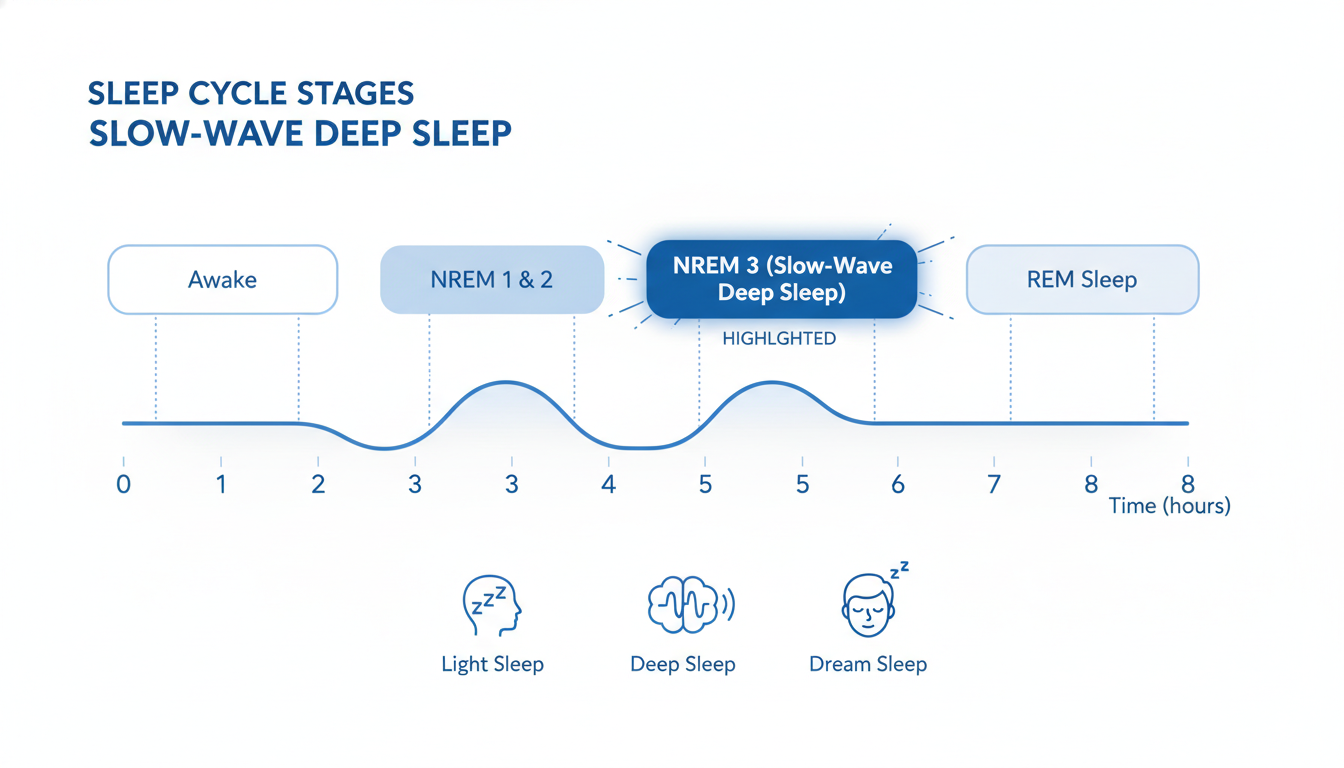
Deep sleep (NREM Stage 3) is characterized by slow delta brain waves. Your heart rate drops, breathing slows, and your body releases the majority of its nightly growth hormone.
This is when cellular repair happens, your immune system gets a significant boost, and the brain clears metabolic waste products — including amyloid-beta, a protein linked to Alzheimer’s disease.
Research published in Sleep Medicine Reviews confirms that slow-wave sleep is directly tied to next-day cognitive performance, emotional regulation, and metabolic health.
How Much Deep Sleep Do You Actually Need?
Healthy adults typically spend 13–23% of their total sleep time in deep sleep. For someone sleeping 8 hours, that’s roughly 60 to 110 minutes of slow-wave sleep per night.
Deep sleep is front-loaded — most of it occurs in the first half of your sleep cycle. This is why your bedtime matters just as much as your wake time.
Debunking a Common Myth
Many people believe alcohol helps them sleep more deeply. This is one of the most damaging sleep myths. While alcohol does make you fall asleep faster, it dramatically suppresses slow-wave sleep in the second half of the night.
A review in Mayo Clinic’s sleep guidance confirms that alcohol disrupts sleep architecture, reducing both deep and REM sleep quality — leaving you groggy the next morning regardless of hours slept.
Understanding this science is the first step when you want to improve deep sleep naturally. Now let’s get into the exact actions you can take.
Step-by-Step Improve Deep Sleep Naturally Guide
The Complete Improve Deep Sleep Naturally Protocol
These steps are ranked by impact. Start with steps 1–3 this week, then layer in the rest over the following two weeks.
- Step 1: Set a Fixed Wake Time Every Single Day
Your circadian rhythm is anchored by your wake time, not your bedtime. Choose a consistent wake time — even on weekends — and protect it like a non-negotiable appointment. Do this for just 7 days and most people notice a meaningful improvement in how rested they feel. If you’ve been struggling with an erratic schedule, our guide on how to Reset Circadian Rhythm walks you through the full process. - Step 2: Lower Your Bedroom Temperature to 65–68°F (18–20°C)
Your core body temperature must drop by 1–2°F to initiate and maintain deep sleep. A cool room accelerates this process. Studies show that a sleeping environment above 72°F significantly reduces slow-wave sleep duration. Set your thermostat, use a fan, or try a cooling mattress pad — this single change can add 20+ minutes of deep sleep per night. - Step 3: Get Morning Sunlight Within 30 Minutes of Waking
Exposure to bright natural light in the morning resets your circadian clock and — crucially — increases adenosine pressure, which drives deeper sleep that evening. Aim for 10–20 minutes of direct outdoor light. Even on cloudy days, outdoor light is 10x brighter than indoor lighting. - Step 4: Exercise — But Time It Correctly
Regular exercise is one of the most powerful tools to improve deep sleep naturally. Moderate-to-vigorous aerobic exercise can increase slow-wave sleep by up to 30%. However, timing matters: finish intense workouts at least 3–4 hours before bed to allow your core temperature and adrenaline to return to baseline. Morning or early afternoon is ideal for most people. See our guide on Active Recovery Techniques for low-impact evening movement options. - Step 5: Cut Caffeine After 1 PM
Caffeine blocks adenosine receptors — the exact chemical signal that drives deep sleep pressure. With a half-life of 5–7 hours, an afternoon coffee at 3 PM still has 50% of its caffeine in your system at 8 PM. Switch to herbal tea or water after 1 PM to let your natural sleep drive build throughout the day. - Step 6: Eliminate All Screens 60 Minutes Before Bed
Blue light from phones, tablets, and TVs suppresses melatonin production by up to 50%, delaying your sleep onset and reducing slow-wave sleep time. This is one of the most common barriers people face. Our post on how to Stop Late Night Scrolling offers a practical replacement routine that actually works. - Step 7: Build a Wind-Down Routine Starting 60–90 Minutes Before Bed
Your nervous system needs a transition from alert to restful. A consistent pre-sleep routine signals your brain to begin the melatonin cascade. Include dim lighting, light stretching, reading, or a warm bath. A warm bath 1–2 hours before bed is especially effective — the rapid body cooling afterward mimics the temperature drop that triggers deep sleep. Check out our Evening Self Care guide for a complete routine template. - Step 8: Consider Evidence-Based Supplements
If lifestyle changes alone aren’t enough, certain supplements to increase deep sleep have solid research behind them. Magnesium glycinate (300–400 mg) supports GABA activity and may deepen slow-wave sleep. L-theanine (200 mg) promotes relaxation without sedation. Low-dose melatonin (0.5–1 mg) may help shift your sleep timing. Always consult your healthcare provider before starting any supplement.
- Temperature: Keep your bedroom at 65–68°F for optimal slow-wave sleep.
- Consistency: Wake at the same time every day, including weekends.
- Light exposure: Morning sun in, blue light out before bed.
- Exercise timing: Finish intense workouts 3–4 hours before sleep.
- Caffeine cutoff: Nothing caffeinated after 1 PM.
- Alcohol: Eliminate or significantly reduce — it is a deep sleep suppressor.
- Wind-down: Start your pre-sleep routine 60–90 minutes before your target bedtime.
- Supplements: Magnesium glycinate and L-theanine are among the strongest natural sleep aid options backed by research.
Improve Deep Sleep Naturally: Mistakes to Avoid
Mistake #1: Using Alcohol as a Sleep Aid
As mentioned above, alcohol is perhaps the biggest enemy of deep sleep. Even one or two drinks within three hours of bedtime can reduce slow-wave sleep by 20–40%.
You may fall asleep faster, but you’ll spend less time in the restorative stages your body actually needs. If you’re serious about how to sleep better at night naturally, reducing alcohol is non-negotiable.
Mistake #2: Inconsistent Sleep Timing
Sleeping in on weekends feels like recovery, but it actually creates “social jet lag” — a misalignment of your internal clock that makes deep sleep harder to achieve all week long.
Studies show that even 90 minutes of schedule variation on weekends can blunt slow-wave sleep quality for two to three subsequent nights. Consistency is the single highest-leverage habit for better sleep architecture.
Mistake #3: Napping Too Late or Too Long
Long or late-afternoon naps reduce adenosine buildup — the sleep pressure that drives deep sleep at night. If you nap, keep it to 20 minutes and finish before 2 PM.
Longer naps can leave you in sleep inertia (that groggy, disoriented feeling) and eat into your overnight slow-wave sleep budget.
Mistake #4: Overlooking Stress and Cortisol
Elevated evening cortisol from chronic stress directly suppresses slow-wave sleep. Your body cannot shift into deep sleep while in a state of physiological alertness.
Practices like journaling, breathwork, or gentle yoga before bed help lower cortisol levels before sleep. Waking anxious and unrested often stems from this — our guide on how to Reduce Morning Anxiety covers the cortisol-sleep connection in detail.
Start Your Improve Deep Sleep Naturally Journey Today
The best way to improve deep sleep naturally isn’t to overhaul everything at once. Start with just two actions tonight.
Action 1: Set your thermostat to 67°F before bed tonight.
Action 2: Choose a fixed wake time for the next 7 days — and stick to it no matter what.
These two changes alone may help you notice a real difference in how rested you feel within one week. They cost nothing, require no supplements, and take less than five minutes to implement.
From there, layer in the additional steps — screen curfew, morning sunlight, caffeine cutoff, and your evening wind-down. Each habit compounds on the others. Within 2–4 weeks, many people report dramatically improved morning energy and mental clarity.
You deserve to wake up feeling genuinely restored. Learning how to improve deep sleep naturally is one of the highest-return investments you can make in your long-term health — and you can start right now.

Frequently Asked Questions
How to induce deep sleep naturally?
The most effective ways to induce deep sleep naturally include cooling your bedroom to 65–68°F, maintaining a fixed sleep schedule, avoiding caffeine after 1 PM, and doing 20–30 minutes of aerobic exercise earlier in the day. A warm bath 1–2 hours before bed can also trigger the body-cooling response that initiates slow-wave sleep. Consistent practice of these habits over 7–14 days yields the most noticeable results.
Does sleep affect A1C levels?
Yes — poor sleep, particularly insufficient deep sleep, is associated with higher blood sugar levels and elevated A1C over time. Deep sleep plays a critical role in insulin sensitivity; when slow-wave sleep is disrupted, the body processes glucose less efficiently. Adults with chronic sleep deprivation have been shown in multiple studies to have significantly higher A1C levels compared to those who sleep well consistently.
What is the 10 3 2 1 0 rule for sleep?
The 10-3-2-1-0 rule is a pre-sleep timing framework: no caffeine 10 hours before bed, no large meals or alcohol 3 hours before bed, no more work or mentally stimulating tasks 2 hours before bed, no screens 1 hour before bed, and 0 snooze button presses in the morning. This rule is a practical way to improve deep sleep naturally by managing the inputs that most disrupt sleep architecture. Following even three of these five guidelines can meaningfully improve slow-wave sleep duration.
How to get 50% deep sleep?
Getting 50% of your sleep in the deep stage is not a realistic or healthy target — normal deep sleep accounts for 13–23% of total sleep time in healthy adults. Chasing a higher percentage can create unnecessary anxiety about sleep tracking numbers, which itself disrupts sleep quality. Instead of focusing on percentages, focus on the habits that improve deep sleep naturally — consistent timing, cool temperatures, exercise, and limiting alcohol — and let your body optimize its own sleep architecture.
”
}