
Table of Contents
Why You Wake Up Stiff and Low-Energy
A consistent morning stretching routine may be the single most effective habit you can build to transform how you feel every single day. If you roll out of bed feeling like a rusty hinge, you are not alone.
During sleep, your body stays mostly still for six to nine hours. Circulation slows, your fascia — the connective tissue wrapping your muscles — slightly stiffens, and synovial fluid in your joints needs movement to redistribute properly.
The result? That familiar morning ache in your neck, lower back, and hips. Desk workers experience this even more intensely because sitting already shortens hip flexors and tightens the thoracic spine before the day even begins.
According to the Mayo Clinic’s guide to stretching, regular flexibility work improves posture, increases range of motion, and helps reduce everyday muscle tension — all things that start the moment you swing your legs off the mattress.
The good news? You don’t need an hour or a gym membership. A focused 10-minute morning stretching routine targeting your most tension-prone areas is enough to wake your body up and set a calm, energized tone for the day ahead.
The Science Behind Your Morning Stretching Routine
Understanding the “why” behind your morning stretching routine makes it far easier to stay consistent. Let’s look at what the research actually says.
What Happens to Your Body During Sleep
Fascia — the thin web of connective tissue surrounding every muscle — loses some of its pliability overnight due to reduced hydration and movement. Gentle stretching literally rehydrates and re-lengthens these tissues, restoring your normal range of motion within minutes.
A 2019 review published in the Journal of Sports Science & Medicine on static stretching and flexibility found that consistent static stretching — holding a position for 20–30 seconds — produced significant improvements in range of motion compared to no stretching at all.
Stretching, Cortisol, and Your Mood
Morning cortisol naturally peaks within 30–45 minutes of waking (known as the cortisol awakening response). Pairing slow, diaphragmatic breathing with your morning stretching routine may help modulate this spike, leaving you calmer and more focused rather than anxious.
Research from Harvard Health has highlighted the stress-reducing power of controlled breathing, which works synergistically with gentle movement to down-regulate your nervous system.
Debunking a Common Myth
Many people believe morning stretching must be intense to be effective. That’s simply not true. Your muscles are at their coolest and least pliable right after waking. Gentle, static stretches held for 20–30 seconds are far safer and more effective than aggressive or bouncy movements first thing in the morning.
When combined with a Morning Walk Routine, your stretching practice creates a powerful two-part morning movement habit that builds momentum for the rest of your day.
Your Step-by-Step Morning Stretching Routine
This 10-minute morning stretching routine is designed specifically for beginners and desk workers. No equipment is needed — just a yoga mat and about 10 minutes of floor space. Work through each move in order without rushing.
Pro tip: Breathe slowly and deeply throughout every single stretch. Inhale for 4 counts, exhale for 4 counts. This transforms a simple morning stretching routine into a genuine mind-body reset.
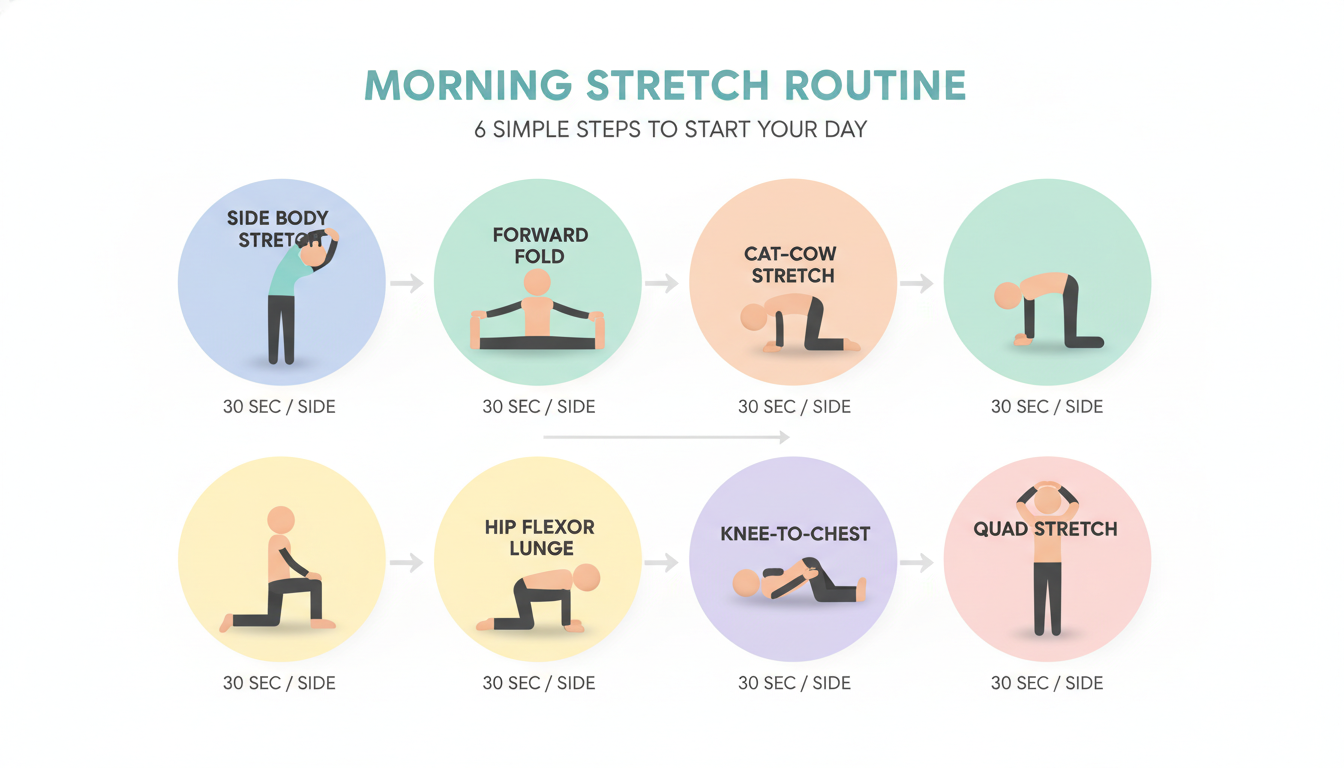
The Complete 10-Minute Morning Stretching Routine
-
Supine Knee-to-Chest (60 seconds — 30 seconds each leg)
Lie flat on your back. Draw your right knee toward your chest and hold it gently with both hands. Feel the release in your lower back and hip. Hold 30 seconds, switch sides. This is your gentle “wake-up” signal to your spine. -
Cat-Cow Stretch (90 seconds — 8–10 slow cycles)
Move to all fours, wrists under shoulders, knees under hips. Inhale and drop your belly, lifting your head and tailbone (cow). Exhale and round your spine toward the ceiling, tucking chin and pelvis (cat). This mobilizes every segment of your spine and is the cornerstone of any morning stretching routine for beginners. -
Child’s Pose (30 seconds)
From all fours, push your hips back toward your heels, extending your arms forward on the mat. Let your forehead rest down. This opens the thoracic spine and stretches the lats — critical relief for desk workers. -
Seated Neck Rolls (60 seconds)
Sit cross-legged or on the edge of your bed. Slowly drop your right ear toward your right shoulder and hold for 15 seconds. Repeat on the left. Then gently roll your chin toward your chest and back up. Never roll your head fully backward — that compresses the cervical spine. -
Doorway or Cross-Body Shoulder Stretch (60 seconds — 30 seconds each side)
Bring your right arm across your chest at shoulder height. Use your left forearm to gently press it closer to your body. Hold 30 seconds. Switch. This releases the posterior shoulder capsule — a major tension hotspot for anyone who sits at a computer. -
Low Lunge Hip Flexor Stretch (90 seconds — 45 seconds each side)
Step your right foot forward into a lunge, lower your left knee to the mat. Shift your weight forward gently until you feel a deep stretch in the front of your left hip. Hold 45 seconds. This is non-negotiable for desk workers whose hip flexors shorten from prolonged sitting. -
Seated Forward Fold / Hamstring Stretch (60 seconds)
Sit on the mat with both legs extended straight in front of you. Hinge forward from your hips (not your waist), reaching toward your feet. Hold wherever you feel a gentle pull — no pain. Hold 30 seconds, release, repeat once. Tight hamstrings are one of the biggest drivers of lower back pain. -
Supine Figure-4 Piriformis Stretch (60 seconds — 30 seconds each side)
Lie on your back, knees bent. Cross your right ankle over your left thigh to create a figure-4 shape. Flex your right foot and gently press your right knee away from you. Hold 30 seconds, switch. This targets the piriformis muscle — a deep hip rotator that becomes chronically tight from sitting. -
Spinal Twist (60 seconds — 30 seconds each side)
Still lying on your back, draw both knees to your chest, then let them fall to the right while you extend your arms into a T-shape. Look left. Hold 30 seconds, switch. This decompresses the lumbar spine and improves thoracic rotation. -
Standing Forward Fold Finish (30 seconds)
Stand up slowly. Hinge at your hips and let your upper body hang loose toward the floor, bending your knees slightly. Let gravity do the work. Take three deep breaths here. Slowly roll back up, vertebra by vertebra, letting your head come up last. You’re done!
- Total time: Approximately 9–11 minutes
- Frequency: Daily — even 5 of these 10 moves beats skipping entirely
- Hold time per stretch: 20–30 seconds minimum for flexibility gains
- Breathing: Slow, nasal breathing throughout — 4 counts in, 4 counts out
- Pain rule: Mild tension is fine; sharp or stabbing pain means stop immediately
- Best surface: A non-slip yoga mat on a hard floor for best stability
Pairing this morning stretching routine with dedicated work to improve body awareness will help you identify exactly where your tightest areas are so you can prioritize those stretches on busy mornings.
Morning Stretching Routine Mistakes to Avoid
Even the best morning stretching routine can deliver poor results — or even cause injury — if you approach it the wrong way. Here are the four most common mistakes beginners make and exactly what to do instead.
Mistake 1: Bouncing Through Your Stretches (Ballistic Stretching)
Bouncing in and out of a stretch — known as ballistic stretching — activates your muscle’s stretch reflex, which actually causes the muscle to contract rather than release. This increases your injury risk, especially first thing in the morning when your tissues are coolest.
Do this instead: Move slowly into each position and hold it completely still for 20–30 seconds. Let your nervous system relax into the stretch rather than fighting it.
Mistake 2: Skipping the Breath
Most beginners focus only on the physical position and forget about breathing. Shallow or held breath keeps your nervous system in a mild stress state, which increases muscle tension — the opposite of what you want.
Do this instead: Use slow, controlled nasal breathing throughout your entire morning stretching routine. Each exhale is an opportunity to soften a little deeper into the stretch.
Mistake 3: Stretching Through Sharp Pain
There is a clear difference between the productive discomfort of a deep stretch and the warning signal of sharp, shooting, or joint-based pain. Pushing through the latter risks real tissue damage.
Do this instead: Back off by 20% any time you feel sharp pain. You should always feel mild to moderate tension — never a burning or stabbing sensation. If pain persists, consult a physical therapist before continuing.
Mistake 4: Being Inconsistent
Doing your morning stretching routine three times one week and zero times the next produces minimal results. Flexibility and mobility gains are cumulative — they require consistent daily practice over weeks and months.
Do this instead: Aim for at least 5 days per week. On your busiest days, even doing just 3–4 moves from the sequence is far better than nothing. Build the habit first, then optimize the routine.
If balance feels like a challenge during any standing moves in your routine, our guide to balance exercises for adults has targeted drills that complement stretching perfectly.
Start Your Morning Stretching Routine Journey Today
The most powerful step you can take right now costs zero dollars and takes about 10 seconds: lay your yoga mat out on the floor tonight before you go to bed.
That one small act removes the biggest barrier to starting — the friction of having to “set up” in the morning when your willpower is at its lowest. When your mat is the first thing you see when you wake up, the decision to do your morning stretching routine is already made for you.
Research on habit formation consistently shows that reducing environmental friction is more effective than relying on motivation alone. Make the right choice the easy choice.
Start with just the first five moves from the sequence above. Five minutes is enough to build the habit. Once showing up becomes automatic — usually within two to three weeks — you can expand to the full 10-minute morning stretching routine at your own pace.
You don’t need to be flexible to begin. Flexibility is not a prerequisite — it’s the result. Every single person who is flexible today was once a beginner who simply started and kept going.
As your body opens up and your mornings improve, you may naturally want to add more movement. A gentle Morning Walk Routine pairs beautifully with stretching. You might also explore grip strength exercises to build functional upper-body resilience alongside your new flexibility habit.
And if racing thoughts at night are cutting into your sleep quality — which directly impacts how stiff you feel each morning — our guide on how to stop overthinking at night is worth a read too.
Your morning stretching routine is the foundation. Build it one day at a time, and your body will thank you for years to come.

Frequently Asked Questions
Is it good to stretch every morning when you wake up?
Yes — stretching every morning is one of the most beneficial low-effort habits you can build. It reactivates circulation, loosens fascia stiffened overnight, and signals your nervous system to shift from rest mode into alert, ready-to-move mode. Even five minutes of gentle movement each morning may meaningfully improve how you feel throughout the day.
What is the best morning stretch routine?
The best morning stretching routine is one that targets the areas most prone to overnight stiffness: your neck, shoulders, thoracic spine, hip flexors, and hamstrings. A 10-minute sequence including cat-cow, a low lunge hip flexor stretch, a supine hamstring stretch, and a spinal twist covers all the key bases for both beginners and desk workers. Consistency matters far more than perfection — a simple routine done daily beats an elaborate one done occasionally.
What is the 5 5 5 30 morning workout?
The 5-5-5-30 morning workout is a simple habit framework popularized on social media: 5 minutes of walking, 5 minutes of stretching, 5 minutes of deep breathing, repeated or combined into a 30-minute morning movement block. It’s designed to be low-barrier and accessible for beginners who want to build a sustainable morning movement habit without committing to a full gym session. Pairing the stretching portion with a structured morning stretching routine like the one outlined above makes this approach even more effective.
Can stretching help lower cholesterol?
Stretching alone is unlikely to directly lower cholesterol levels in the way that aerobic exercise does. However, regular flexibility work — especially when part of a broader active lifestyle that includes walking, yoga, or light cardio — may contribute to overall cardiovascular health improvements over time. If cholesterol management is a goal, pairing your morning stretching routine with moderate aerobic activity and a heart-healthy diet is the evidence-based approach recommended by health professionals.